Field site: Pedra Bonita, Rio de Janeiro ~ Status: not yet jumped ~ Hypothesis filed four weeks in advance
On the morning of November 24th, weather permitting, I will run off the edge of a mountain.
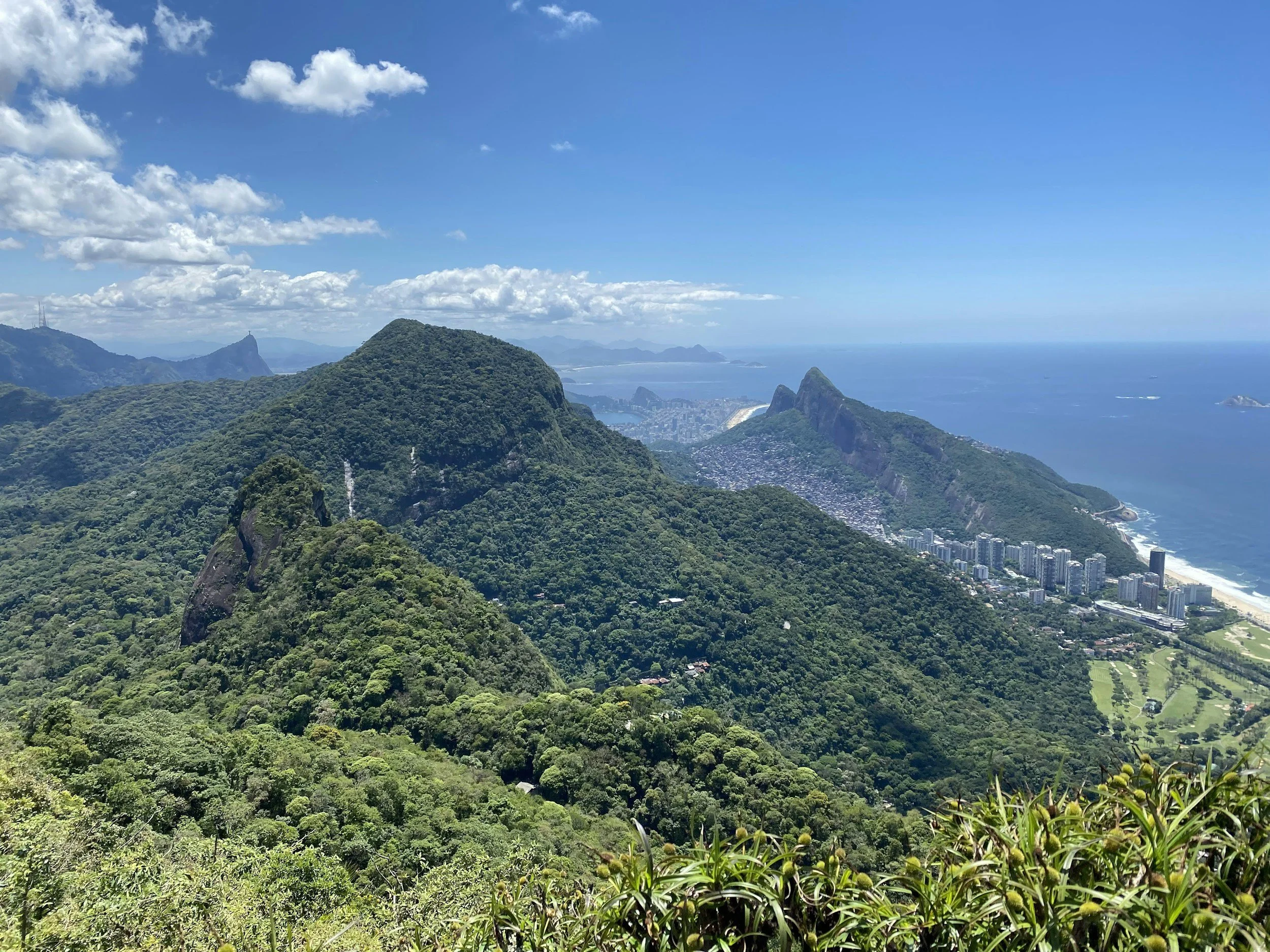
Pedra Bonita
Said mountain I will be running off the edge of.
I’d like the record to show that I’ve agreed to this voluntarily. A paraglider will be attached to me, and a qualified pilot will be attached to the paraglider, and together we’ll launch from a ramp roughly 500 metres above the Atlantic and float down to a beach in São Conrado. It has been on my list for a while now, as a challenge for my fear of heights. So I’m definitely, to use the technical term, terrified.
I’m doing what any trained observer would do in the presence of an overwhelming phenomenon. I’m taking notes.
This post is two things at once. It’s a field guide to the place I’ll be jumping from, which turns out to have a far richer history than “scenic launch site.” And it’s a method I’ve been practising for years and never written down properly: how to journal a fear before you face it, and after, so that the thing you were frightened of becomes something you understand.
The Field Site
Pedra Bonita, “pretty stone,” is a granite dome in the mountains of Rio’s Tijuca National Park, the dense forest that runs through the middle of the city. From the top you can see the long curve of São Contrado beach below, the favela of Rocinha climbing the hillside, and next door, the much larger bulk of Pedra da Gávea, which looks unsettlingly like a giant face staring out to sea.
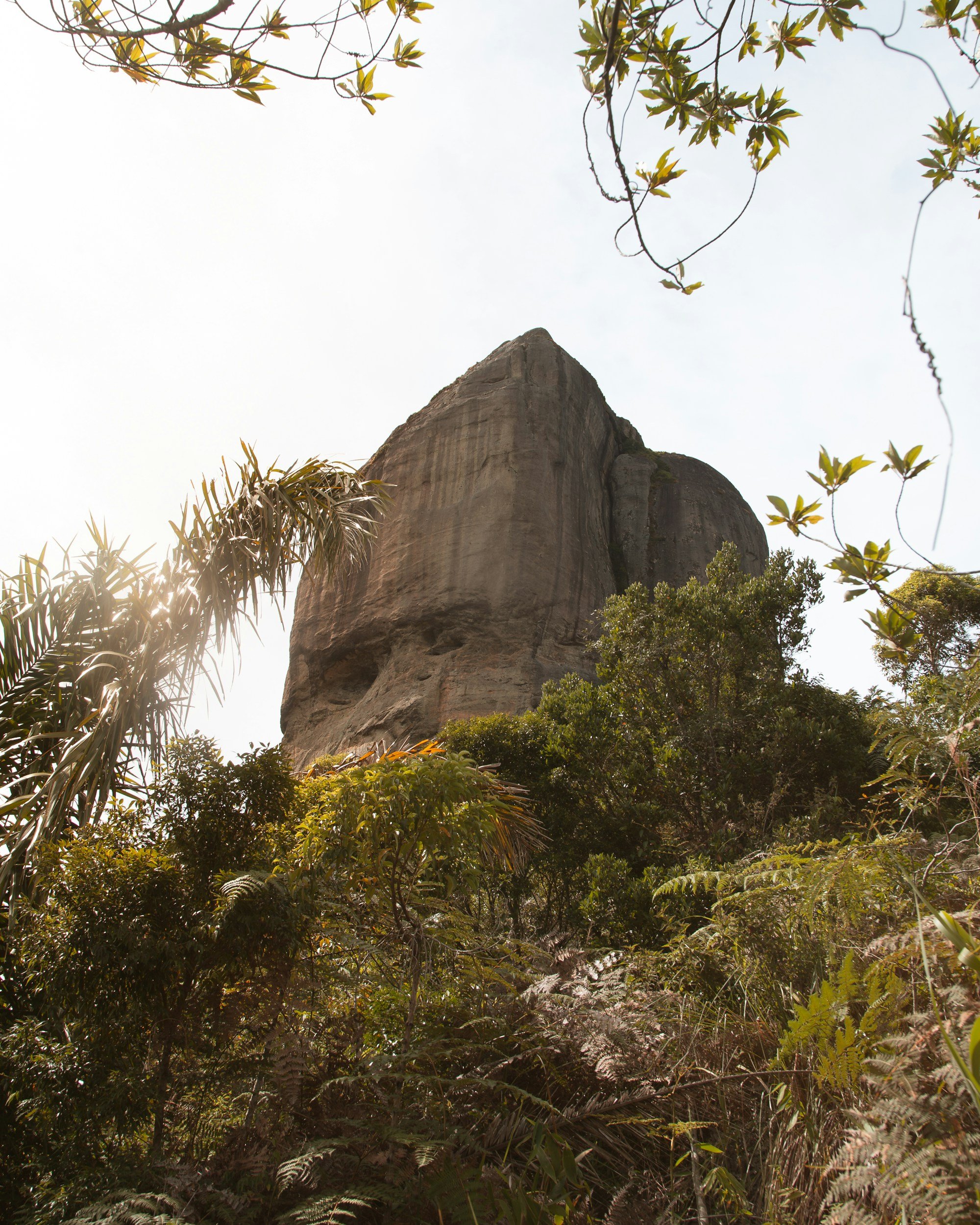
Pedra da Gávea- kinda like the heads from Easter Island.
The launch sits at about 500 metres. There’s a ramp for hang gliders to take off from at the highest point, and paragliders launch from an area just below it. A tandem paraglide starts with a few running steps. You and the pilot move forward together while the wing fills with air overhead, and somewhere in those steps your feet stop finding the ground. If all goes well, you land on Praia do Pepino, a stretch of São Conrado beach directly below.
That beach is named after a person. Pepe Lopes was a Rio surf champion who became one of the people who brought free flight to Brazil. He and a group of fellow enthusiasts built a ramp on Pedra Bonita and started jumping off it, landing on that particular patch of sand. He went on to win the hang gliding world championship in 1981, and he died in 1991 during a competition in Japan. The landing beach, Pepino, “little Pepe,” still carries his name. Pedra Bonita is often called the birthplace of hang gliding and paragliding in Brazil, and in high season it now sends more than two hundred tourist flights a day down to his beach.
The flight itself typically lasts somewhere between ten and fifteen minutes, longer if the air is generous. For something I’ve been anticipating for years, that’s a very short field season.
A Forest Put Back By Hand
Here is the part that changed how I think about this jump.
The green mountainside I’ll be floating over looks ancient. It isn’t, or at least not in the way it appears. By the middle of the nineteenth century, much of the forest around Rio had been cut down for coffee plantations and charcoal. The consequence was very practical: without trees, the springs that fed the city’s water supply began to fail, and Rio faced a water crisis.
In 1861, the imperial government took control of the land and began to replant it. The project was supervised by Major Manuel Gomes Archer. The work itself was done, at least at first, by six enslaved people: Eleutério, Constantino, Manuel, Mateus, Leopoldo and Maria. Over the following decades, they and the workers who later joined them planted more than 100,000 trees. The Tijuca Forest is, in large part, a forest people built.
We know their names today because Archer kept a diary. According to people who’ve gone looking, there is still no placard in the forest that names and acknowledges them.
I find it difficult to describe how much that detail matters to me, as someone who is building around the idea that writing things down is a way of keeping them. The forest survived and saved the city because six people planted it. Their names survived because one person wrote them down, but they deserve more recognition. Somewhere in that is the whole argument for keeping a notebook.
A Country That Takes Flight Personally
Brazil has a particular relationship with leaving the ground.
Ask most people who invented powered flight, and they’ll say the Wright brothers. Ask again in Brazil, and you’re likely to hear a different name: Alberto Santos-Dumont. On November 12th, 1906, in a park on the edge of Paris called Bagatelle, Santos-Dumont flew his aircraft, the 14-bis, 220 metres in a little over 21 seconds before a crowd of witnesses, and won a prize from the Aero Club de France for doing it. Because his flight was public and his aircraft took off under its own power, many Brazilians regard him as the true father of aviation, and the argument is still conducted with feeling.
November 12th, 1906, as it happens, is exactly 120 years before the day that this forthcoming trip begins. I didn’t plan that, obviously, but I’m choosing to take it as a sign.
People have been writing about flight for a lot longer than they’ve been doing it. In Ovid’s Metamorphoses, Daedalus builds wings of feathers and wax for himself and his son Icarus and warns him to fly the middle course, not too low and not too high. Icarus, famously, doesn’t listen. Around 1505, Leonardo da Vinci filled a small notebook, now known as the Codex on the Flight of Birds, with drawings and observations of how birds move through the air, trying to work out how a person might do the same.
I take comfort in that notebook. Even Leonardo da Vince, when faced with flight, started by writing it down.
Running off a hill has its own notebook-keeper. In the 1980s, the German engineer Otto Lilienthal built a series of gliders, ran down hillsides outside of Berlin, and launched himself into the air more than two thousand times. He steered by shifting his body weight. Before any of that, in 1889, he published a careful study of how birds fly, Birdflight as the Basis of Aviation, built from years of observing them. Every pilot who still takes off on foot, paraglider pilots included, starts the way he did, with a few running steps and a lot of faith in the air. His method is the one I’m borrowing for my flight: watch closely, write it down, then run.
The Anthropology of Jumping Off Things
In 1909, the folklorist Arnold van Gennep published The Rites of Passage, a book about the ceremonies that move people from one state of life to another: birth, coming of age, marriage, death. He noticed that these rituals almost always have three stages. First comes separation, when you leave your old status behind. Then comes a transitional stage, when you’re no longer what you were and not yet what you’ll become. Finally, there’s incorporation, when you return to ordinary life changed.
Half a century later, the anthropologist Victor Turner became fascinated by that middle stage, which van Gennep had called liminal, from the Latin limen, threshold. Turner described people in it as “betwixt and between”: outside the normal rules, suspended, often a little frightened, and usually open to transformation.
I’m not claiming a tandem paraglide is a cultural rite of passage for me. Nobody hands you a new name at the bottom. But the shape is uncannily familiar. You leave the ground. For about ten minutes you are, quite literally, neither here nor there. Then your feet touch the sand, and you’re folded back into ordinary life, sunburnt maybe and somehow different. If there was ever a liminal space experience you could book online, this is it.
Edgework
The sociologist Stephen Lyng has a word for why people do this sort of thing on purpose. In a 1990 paper in the American Journal of Sociology, he called it edgework: voluntary risk-taking, the deliberate act of approaching the boundary between control and chaos. Lyng interviewed and observed skydivers, among others, and found that people at the edge describe remarkably similar experiences: extreme focus, an altered sense of time, a feeling that everything is more real than usual, and a strange difficulty putting any of it into words afterward.
One of his observations stopped me cold. At the height of the experience, he wrote: “the reflective self is not simply resent.”
That’s the problem, isn’t it? The part of you that would notice and remember and make meaning goes missing at exactly the moment you’d most like it there. Which is, I’d argue, precisely why you need a notebook. If the reflective self can’t come with you over the edge, it can wait for you on either side of it.
Which Fears We Choose
The anthropologist Mary Douglas spent much of her career arguing that what a society fears says as much about that society as about the danger itself. In Risk and Culture (1982), written with the political scientist Aaron Wildavsky, she pointed out that no group can worry about everything, so every culture selects which risks to fear and which to ignore, and those choices reveal its values.
I think the same is true of individuals. My list of fears for this jump turns out to say a lot about me, most of it unflattering and some of it funny. That's the first reason to write it down: you learn what you're actually afraid of, which is rarely the thing you'd have guessed.
Why Writing it Down Helps
The Stoic philosophers had a practice called premeditatio malorum, the advance rehearsal of misfortune. Seneca, in his letters, recommends imagining the things that might go wrong before they happen, not to wallow in them, but so that they lose some of their power to ambush you. If you've already met a fear on the page, it arrives as an acquaintance rather than a stranger.
There's also some modern research worth knowing about, with an important caveat. In 1986, the psychologists James Pennebaker and Sandra Beall asked students to write for fifteen minutes a night, four nights in a row. Some wrote only the facts of a difficult experience, some only their feelings, and some both. The groups who wrote about their emotions showed fewer health problems in the months that followed, and the group who wrote facts alone looked much like the people who'd written about nothing at all.
The caveat: that study was about genuinely painful experiences, not holiday nerves, and it doesn't prove anything about paragliding. But its central finding shapes how I write fear down. The facts on their own don't do much. It's the facts and the feelings, together, that seem to matter.
The Method: a Hypothesis and its Results
This is the practice I’ll be using, adapted from day 11 of my Field Protocol. It works for any bucket-list moment: a first solo trip, a scuba dive, a speech, a mountain.
Before: the Hypothesis
Write this a few days ahead, when the fear is still abstract enough to look at.
Name the fears specifically. Not "I'm scared," but "I'm scared my legs will stop working at the edge of the ramp."
Write what you expect your body to do. Shaking hands, a dry mouth, nervous laughter. Prediction makes it less of an ambush.
Write why you're doing it anyway. This is the line you'll need on the morning of.
Write what you'd say to a friend in your position. We're far kinder researchers when the subject is someone else.
For scientific transparency, here is my own preliminary risk assessment:
The Morning of: Three Lines
Just three. What the sky looks like. How you slept. One sentence about how you feel right now. This is your last entry as the person who hasn't done it yet, and future you will want it.
After: the Results
Write this within a day, before the memory smooths itself over.
Go back through each fear on your list and record what actually happened. Some will have come true, most won't have, and at least one will have turned into something you never thought to worry about.
Record the sensory details: the sound, the temperature, the moment your feet left the ground.
Write your findings. What did you learn about the fear, and about yourself?
And if the flight is cancelled for weather, which is common and sensible, write that down too. A cancelled flight is still data. Your relief, your disappointment, or the unexpected mix of both is a finding in its own right.
A Note on Risk, Honestly
This isn't a post telling you to be brave, or that fear is something to push through no matter what. Some fears are information. The site at Pedra Bonita is overseen by a flying club, and marshals on the ramp check pilot documentation and run safety checks. That's exactly what a nervous person should want. Choose an operator through the club, ask questions, and if the conditions or the pilot don't feel right on the day, walking away is a perfectly scientific result.
The point of writing the fear down isn't to argue yourself out of it. It's to see it clearly enough to make a real decision, and then to remember what it was like, whichever way you go.
Field Reading List
Arnold van Gennep, The Rites of Passage (1909). The original three-stage model of separation, transition and return.
Victor Turner, "Betwixt and Between: The Liminal Period in Rites de Passage" (1967), in The Forest of Symbols. Liminality, thresholds, and why the middle is where change happens.
Stephen Lyng, "Edgework: A Social Psychological Analysis of Voluntary Risk Taking" (1990). On why people walk up to the edge on purpose.
Mary Douglas and Aaron Wildavsky, Risk and Culture (1982). What our fears say about us.
Seneca, Letters from a Stoic. Ancient, brief, and still the best advice on rehearsing what scares you.
Leonardo da Vinci, Codex on the Flight of Birds (c. 1505). Proof that the first step toward flight is a notebook.
Findings Pending
In late November I’ll come back and publish the results: which fears came true, which didn’t, and what it was actually like to leave the ground above a forest that six people planted by hand. If the weather cancels it, I’ll publish that too.
If you’re facing a bucket-list moment of your own, or just a trip that makes your stomach flip, I’ve made something to help. The Fourteen-Day Field Protocol is a free set of daily journaling exercises for travelling observers, and Day 11 is “The Nervous Thing,” laid out as a hypothesis and its results. It’s free for members of the Slow Travel Society, the letter I send once a month from wherever I am.
Join the Slow Travel Society and get the Field Protocol ➡️
Warmly, and slightly nervously, Courtney
