Where I’ll Sit While He Plays: A Slow Guide to Buenos Aires
I only went to Leadenhall Market once. It was one afternoon on one of our London trips, with a mocha, a Regency romance, and a phone buzzing with his score updates. I never went back, and I’ve never needed to. Some places become yours through routine. Others do it in a single sitting, and you carry them home.
Buenos Aires is the first city on our upcoming trip, and I’m hoping for an afternoon like that. I can’t plan one, of course. Leadenhall happened because I wandered, not because I’d circled it on a map and planned my day around it. But I can make room for it. That’s the honest starting point for this guide. I haven’t been yet, and everything you’re about to read comes from the reading, mapping, and daydreaming I’ve done from my desk in Ontario. So this is less a guide to Buenos Aires than a guide to how I’m getting ready to meet it.
What I do know is the shape of the days ahead. The tournament takes the weekend completely, and usually most of the Friday before as well. Those are the days the city will be mine. So this isn’t a list of must-see things. It’s the five days as I’ve planned them, with room left in each for the things that can’t be planned: the neighbourhoods I’ve circled on the map, the cafés I hope will let me linger, and a few rituals I’m planning to borrow from a city that seems to understand slowness better than most.
So, in the grand tradition of anthropologists who arrive somewhere jet-lagged and immediately start taking notes, I’ve organized this guide as a set of field lessons: one per day, each about something worth noticing. My methodology is rigorous. It involves walking, sitting, eating pastries, people watching, and receiving Pokémon scores by text.
Friday: Arriving in Retiro
Field Lesson No. 1- Let the city set the clock
We land on the morning of the Friday before the tournament, after a long overnight flight, which feels like either a very good omen or a very bad one. I’ve chosen to classify it as ‘data’. Our Airbnb is in Retiro, keeping us near the old railway terminal and Plaza San Martín, and the plan for day one is almost no plan at all. Methodology: drop bags, nap (hopefully), walk.
The first lesson of any new place is about time, and Buenos Aires is going to teach it to me whether I like it or not. Porteños eat dinner at none, or ten, or later, and a restaurant at seven is a room full of tourists and staff eating their own meal. The anthropologist Edward T. Hall wrote about how cultures hold time differently. Some treat it like a line of appointments to be kept. Others treat it as something more elastic, shaped around people rather than clocks. I’m Canadian. I grew up eating dinner at like 7 pm every day, and always felt fine about it. So my first job is simply to notice how differently a day can be shaped, and allow my own to be reshaped with the least resistance.
If the timing is kind, the jacarandas will be in bloom; since it’s November, making it spring in Argentina, the city is said to turn purple. I’d like my first real look at Buenos Aires to be from a bench under one of those trees. Benches are one of the most underrated research instruments in travel. From a bench, you can watch how a city uses its public space: who sits alone, who walks a dog, who lies on the grass at four in the afternoon on a weekday as though that were a normal thing to do (it should be).
I’ll also be watching for mate, the bitter herbal tea Argentines drink from a shared gourd through a metal straw. It isn’t just a drink. It’s a social ritual with its own etiquette. The gourd passes around a circle, one person prepares and refills it, and if you say “gracias” when it’s handed back, you’ve just politely announced you’re finished. I find this deeply charming and slightly terrifying. Somewhere in Buenos Aires there is a polite Canadian saying thank you after their first sip, and they’re wondering why nobody is offering them a second taste.
Saturday: Teatro Colón and the Streets around It
Field Lesson No. 2- An old building tells you who a city wanted to be
Saturday is going to be the first tournament day, which makes it the first day that’s only mine of the trip. I’ve planned it around one fixed point: a guided tour of the Teatro Colón, the opera house that has stood near the city’s widest avenue for more than a century and is famous for its acoustics. I’m not really an opera person (except for The Phantom of the Opera), but I’m a big old building person, which is different, and arguably cheaper.
Here’s what I’ll be looking for. The Colón opened in 1908, when Buenos Aires was rich on beef and grain exports and full of new arrivals from Europe. The city liked to call itself the Paris of South America. A building like this isn’t only a theatre. It’s a statement, made in marble and gilt, about who a city believed itself to be and who it hoped would notice. Every grand building is a little like an ambitious cover letter. The fun is in reading between the lines. Who was it built for? Who was meant to sit in the cheap seats? What does it say about a young city that it wanted so badly to seem like an old one?
After the tour, the afternoon is unscheduled on purpose. The streets nearly run toward Avenida Corrientes, with its theatres and bookshops (Buenos Aires is often said to have more bookshops per person than any other city in the world, a statistic I’m prepared to verify personally). They also run towards the historic cafés the city has named bares notables, protected for their history. That’s where Field Lesson No. 2 gets a footnote: in a Buenos Aires café, nobody hurries you. Your coffee often arrives with a small glass of sparkling water. Ordering one cortado and staying two hours isn’t rude. It’s the point. The café works less like a shop than a shared living room, and watching who comes in, who’s greeted by name and who reads the paper at the same table every day will tell me more about the neighbourhood than any guidebook.
Somewhere in the middle of the afternoon, my phone will start buzzing with scores. Field note (written in advance): subject ordered a second medialuna. Hypothesis: it was a close round.
Sunday: San Telmo, La Boca and a Table for Two
Field Lesson No. 3- Objects have biographies, and some streets are performing.
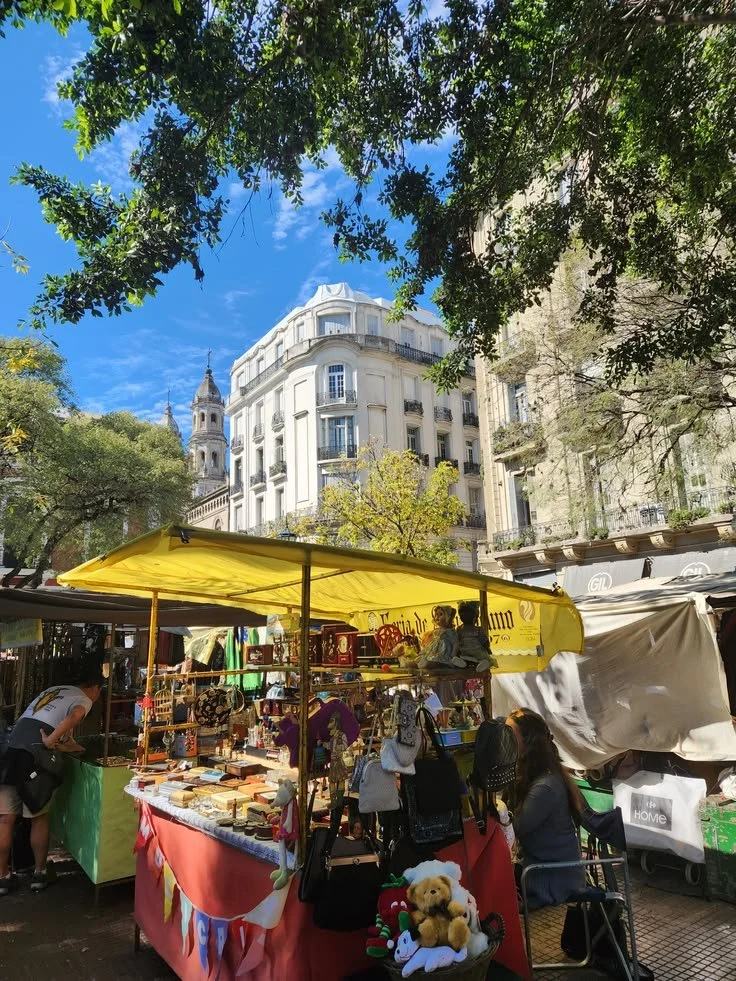
Sunday is the last tournament day in Argentina, and the one I’m most looking forward to. In the morning, I’ll go to the San Telmo Sunday market, the antiques fair that fills Calle Defensa and Plaza Dorrego every week with old soda siphons, silverware, records, postcards, and tango dancers in the square.
Anthropologists have a lovely idea for places like this. Arjun Appadurai and Igor Kopytoff wrote about the “social life” and “biography” of things: an object isn’t just an object; it’s a life and story. It was made, sold, used, loved, forgotten in a drawer and sold again, gaining meaning each time it has changed hands. A flea market is an unofficial museum, where every exhibit is on its second or third life, and the labels are missing. So my lesson for the morning is to look at the stalls and ask who owned this, what was that for, why someone kept it long enough for it to end up here. I’ll also be shopping for paper (old tickets, labels, and postcards) for my junk journal, because paper is the anthropologist’s excuse for buying everything flat.
In the afternoon, I’ll head to La Boca and Caminito, the street of brightly painted corrugated-iron houses tied to the port’s immigrant families. The story goes that they painted with whatever was left over from the shipyards. It’s the most photographed corner of the city, and I know it’s busy. This is where the second half of the lesson comes in. The sociologist Dean MacCannell coined the phrase “staged authenticity” for the places tourism builds to show us a culture’s “real” life, a kind of front stage arranged for visitors, with the actual back stage somewhere just out of view. That isn’t a reason to skip Caminito. It’s a reason to enjoy the performance while also noticing it is one, and to wonder what the neighbourhood’s ordinary Sunday looks like two streets over. (A practical guide note: the advice I’ve seen consistently is to stay around Caminito and go in daylight, so that’s my plan.
Then the tournament ends, and the next part of the trip becomes ours. We’ve planned a splurge parrilla dinner to celebrate, whatever the result. An Argentine grill dinner has its own ritual order. It starts with grilled provolone, which is a sentence I’d like to live inside, and moves slowly through the cuts. At a home asado, it’s customary to give the person who did the grilling a round of applause; I think every culture should adopt this practice for everyone who cooks. After the food comes sobremesa, the long stretch of time spent at the table once the plates are cleared.
This is the companion’s (me) favourite moment of any tournament trip. Jackson will tell me about the games, round by round, and I’ll understand perhaps forty percent of it. I’ll tell him about the market and the painted street, and he’ll feel FOMO as if his day wasn’t super exciting. Somewhere in the overlap, the trip finally has both of us in it.
Monday: MALBA, Together
Field Lesson No. 4- Notice who is telling the story.
Monday will be our first full day together in the city, and we’re spending it at MALBA, the museum of Latin American Art in Palermo. The collection covers twentieth-century work from across the continent, including a Frida Kahlo self-portrait. The lesson I’ll carry in is a simple one: for a long time, the story of Latin American art was mostly told from somewhere else, in European and North American museums and galleries. A museum like this is a continent telling its own story in its own order. That’s worth noticing, because the question of who gets to describe a culture is the oldest in my discipline.
The painting I am most looking forward to seeing is Abaporu, by the Brazilian modernist Tarsila do Amaral. Its title comes from Tupi-Guarani and means roughly “the man who eats people,” and it inspired the 1928 Anthropophagic Manifesto. That was a Brazilian argument that the country should “cannibalize” European culture, meaning swallow it whole, digest it, and make something entirely its own. A painting about cannibalism, recommended to you by an anthropologist, is possibly the most on-brand sentence I’ve ever written. It’s also the perfect bridge to Brazil, the second half of our trip (as long as the painting is actually on the walls, since art does love to travel on loan).
There’s a second quieter lesson on Monday. It’s the first day I’ll get to watch Jackson see the city, not just hear about his day in it. Seeing a museum with someone teaches you how they look: what do they walk past, what stops them, and how long do they stand? After two days of observing Buenos Aires, I’ll get to observe someone else observing it, which is the kind of meta-recursive nonsense anthropologists love.
Tuesday: Palermo, and the Question of Tango
Field Lesson No. 5- Know the difference between watching and being invited.
Tuesday is a flex day, and in my vocabulary that means it’s a day for wandering. Palermo is the city’s largest neighbourhood and seems to hold several cities at once: the café-lined streets of Palermo Soho, and the parks, rose garden, and Japanese garden further out. I’ve read that you’ll see professional dogwalkers here leading a dozen or more dogs at once, like a very small, very disorganized parade. I’ll be counting, for this is rigorous research, of course.
In the evening, we may go to tango, and there’s a real choice to make. A tango show is a performance built for an audience. A milonga is where people actually go to dance, late at night, by their own codes. You’re welcome to watch from the edges, but the floor runs on rules you have to learn by noticing.
The most famous of these rules is the cabeceo. Instead of walking over and asking someone to dance, you catch their eye across the room and give a small nod. If they nod back, you’ve agreed to dance, and nobody had to risk a public refusal. If you were reading last week’s letter, you’ll recognize what this is. It’s Gilbert Ryle’s wink, alive and well on a dance floor in Buenos Aires. To an outsider, it looks like nothing at all, two people glancing at each other. To everyone who knows the code, it’s a whole conversation. That’s exactly the difference between thin and thick description.
My field lesson for the night is to watch the room the way the room watches itself. Who sits where, how long people wait between dances, and what happens when the music stops between songs. My most important personal research goal is to avoid scratching my nose at the wrong moment and accidentally agreeing to dance with a stranger. As a companion traveller, sitting at the edge of the room and learning its rules from the outside is a seat I know very well.
On Wednesday the journey will continue when we fly to São Paulo.
Methodology Appendix: Two Field Notebooks, One Journal
Every serious research paper ends with a methods section, where the authors confess how they actually did the work. Here is mine.
For this trip I’ve made a shared journal in the Letters To Somewhere digital archive, and I’ve added Jackson to it. That means we both write in the same journal, like a memory bank, but every entry sits under its author’s name. On Saturday and Sunday, the entries will be mine: the Colón, the cafés, the market, the painted street. Jackson can add logistical fact tracking to remember his scores. On Monday and Tuesday, we’ll be in the same places on the same days, and that’s where it gets interesting.
Anthropologists have a long tradition of collaborative ethnography: the idea that a place is better understood when more than one person describes it, and when the people being described get a say in the description. I’m not claiming a shared travel journal is a formal research method. But I am claiming that two people who stood in front of the same painting at MALBA will have written down two completely different paintings, and I’d like to read both. One of us will note the brushwork. The other will note that the café downstairs had excellent medialunas. Science needs both.
What I love most is the comments. Jackson can comment on my entries, and I can comment on his, so the journal becomes a conversation as well as a record. I’m fully expecting my long reflection on the Teatro Colón as a statement of civil identity to receive a single comment, something like “nice ceiling.” I’ll treat that as primary-source data and cherish it accordingly. If we make our journal public on the app, then you’ll be able to read along and comment too. Then the field notes have peer reviewers, and peer reviews have never had such a good excuse to include photos of steak.
This is really the reason I designed the app the way I did. A trip shared by two people isn’t one story. It’s two stories that keep running into each other, and the most interesting things often happen in the overlap. The same overlap happens at the parrilla on Sunday night, where we each understand forty percent of each other’s day. A shared journal just lets you keep it.
If you’re travelling with someone this year, whether a partner, a friend, your mom, or a whole family with wildly different ideas about breakfast, you can start a shared journal on Letters To Somewhere and add them to it. Everyone writes under their own name, and no one has to agree on what happened.
Before the Next Letter:
So that’s Buenos Aires, at least as it exists in my planning and dreams, five field lessons, one opera house, one antiques market, one painting about cannibalism and a strong intention to avoid scratching my nose at milonga. In a few weeks, I’ll find out how much of it survives the actual city, and what extra is uncovered by what I find. Fieldwork has a way of rearranging your hypotheses, and I’m looking forward to being wrong in an interesting way.
But I have noticed a problem with this whole plan. Every lesson in this letter depends on noticing, and a lot of what’s worth noticing is said out loud, in a language I’m starting to learn. So next week’s letter is about the words: the Spanish and Portuguese I’m trying to learn before we arrive, and why learning even a few of them will change what a traveller is able to see.
If you’d like letters like this to find you, join the Slow Travel Society newsletter. It’s one honest letter a month, written like an actual correspondence, and in November it will come to you from the road. Methodology: walking. Findings: forthcoming.
