Travelling for Someone Else’s Reason: Notes from the Companion Seat
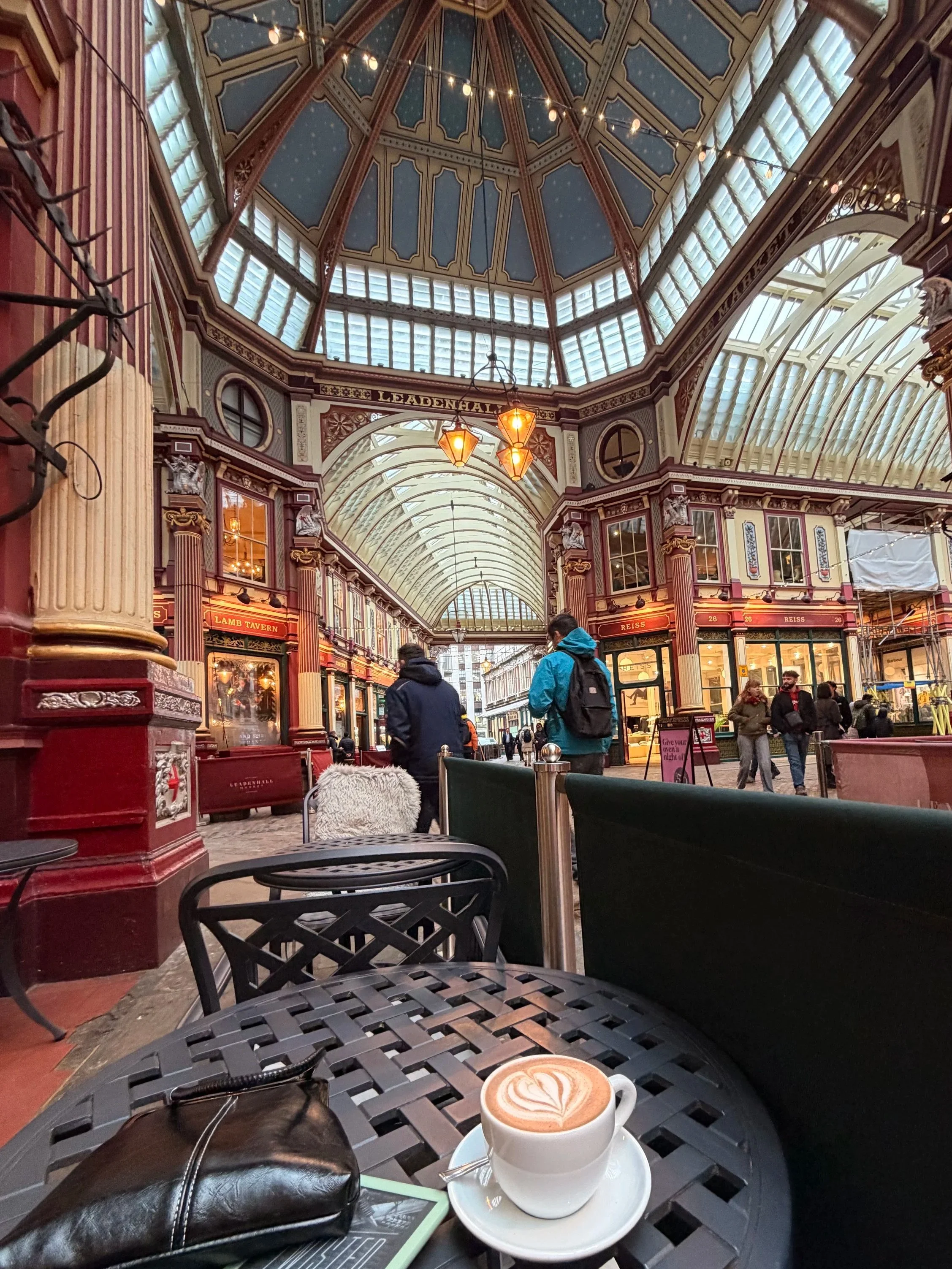
Leadenhall Market, London, England
The texts came through the way they always do on tournament days. Fast, fragmented, and slightly out-of-breath sounding, even in writing.
“Another win! 4-1-0 now.”
I was sitting under the painted roof of Leadenhall Market with a mocha latte going lukewarm beside me and my Kindle open to a Regency-era romance novel, somewhere in the middle of a chapter I’d been working on at this cafe. Fitting, really; a book full of people waiting on letters. Around me, the city was doing its version of a slow afternoon. People drifting through the shop doors, the low clatter of mugs and iron chairs scraping the stone floor, and the slowly shifting gleam of colour from the light shining through the stained glass dome above the centre crossing.
About a thirty-minute train ride away, my boyfriend was getting a short break between rounds, waiting to find out his next pairings, but spending the time to give me a quick update on his score. I didn’t know the name of the deck he was facing next, and I couldn’t really explain the results if you asked me. My version would be way too dumbed down. But I knew exactly what those few rushed words meant, and I sat there smiling at my phone like it was a letter.
That’s what it is like, travelling for someone else’s reason. You’re there for the whole story, but sometimes you’re reading it from somewhere else.
The Companion Seat
I’ve been doing this for four years now. Sporadic trips at first, but now it’s a yearly ritual: my boyfriend competes at the European International Championships in London, and every year I go with him. I’m not a Pokémon player. I’m the companion: the one who comes along, who plans the vacation around the tournament dates that I don’t get to choose, and who knows that on tournament days, she’ll mostly see him in text messages.
Travelling this way has its own quiet logistics. Tournaments are always on weekends, so planning activities for the weekdays when we can both go, or finding accommodations that are close enough to the venue for his early mornings. And it has its harder edges too. Spending my birthday wandering alone in a cold city because it lined up with a Saturday this year, meaning he’s in a tournament until after dinner. Battling the fear and loneliness of slipping in and out of the companion and solo traveller position throughout every trip.
But over the years I’ve come to think of it as a vantage point rather than the sidelines. I used to be too intimidated to really branch out on my own, so I felt trapped hovering like a ghost. Trying to be near to the action, but not so close that I’m imposing on his focus and flow of the matches. So I’ve discovered the joy of solo travel days. The solo days have given me more freedom and no-agenda itineraries that allowed me to discover the simplicity of slow travel. It started from that fear of being a solo traveller. I wouldn’t commit to anything by not booking tickets in advance; that way, if I chickened out, I could bail and go to the tournament instead, where I didn’t feel unsafe and alone. The result was early mornings of wandering between little shops, quaint cafes, and taking the time to notice the people around while I waited in lines for museums, and finding that routine has built my confidence as a traveller. I’ve also spent enough time around the tournament world now to understand its rhythms without ever being a part of it. I can sense when his score is getting high that he is more likely to play on the livestream mainstage, so an open itinerary allows me to drop my solo plans to go support him in a big match. When I’m there, I watch how he scopes out the competition trying to connect with other players, find out what other people are playing and create strategies for the different match-ups he might face.
My anthropology degree has a name for this kind of looking. Anthropologists call it participant observation: living alongside a community long enough that its ordinary routines start to make sense from the inside. Bronislaw Malinowski made it the backbone of fieldwork over a century ago, famously pitching his tent in the Trobriand village instead of watching from the comfort of a mission veranda like the observers before him. I’m not claiming the tournament halls are the Trobriand Islands, but after years of pairings, best-of-threes, and rushed lunches between rounds, I’ve absorbed the rhythms of a world I’ve never actually been a member of.
Clifford Geertz, whose idea of thick description sits at the heart of everything I write here, borrowed an example from the philosopher Gilbert Ryle to explain why that kind of understanding matters. Imagine two boys, each quickly closing one eye. One has a twitch. The other is winking at a friend. Physically, they’re doing the same thing. The difference lives entirely in the meaning, and you can only see it if you understand the world the gesture belongs to. A thin description records the movement. A thick one knows it’s a wink.
My boyfriend’s texts are my winks. To anyone glancing over my shoulder in Leadenhall, “another win! 4-1-0” would have been a handful of characters and not much else. But I could read the whole shape of his morning in it. Whether he was relieved or rattled, whether the round had been close, whether he’d remembered to eat. I couldn’t tell you which card or move won the game, but I could tell you exactly how it felt. That’s the companion’s kind of knowing. It isn’t the player’s, and it isn’t a stranger’s either. It sits somewhere in between.
Three Cities, Two Tournaments, One Notebook
This November, those texts will find me somewhere new. In the second week of November, we leave for South America: five days in Buenos Aires, four in São Paulo, and three in Rio de Janeiro. It’s my first time on the continent, and my first time in either country. Two new stamps for my digital passport and two new languages, and a spring that arrives in November.
The shape of the trip will be familiar, even if everything else isn’t. Jackson’s two tournaments set the dates and the cities, and the rest of the trip arranges itself around them. On his tournament days, I’ll be on my own, which means the parts of this trip that are mine alone are already sitting in the calendar, quietly waiting to be filled.
There are things I don’t know yet. I don’t know exactly when we’ll leave São Paulo, because that depends on whether Jackson makes it to the top 8, and I’ve learned not to plan too firmly around a result that hasn’t happened. I don’t know which cafe in Buenos Aires will become my Leadenhall, or whether I’ll find one at all. There’s one thing on this trip I’m genuinely nervous about, and I will share that closer to the date. And honestly, I don’t know yet what this trip will be for me.
Borrowed Reasons
Here’s what years of London have taught me: a borrowed reason for going somewhere can still turn into your own. I didn’t choose Leadenhall Market. The tournament chose London, and London led me there. But that afternoon, with the mocha, the Kindle and the buzzing phone, belongs entirely to me now, and no result in any tournament hall could change that.
Slow travel is often described as a choice: choosing a destination, the pace, and the reason. I’ve come to think that’s only half of it. The other half is what you do once you’re there, whatever reason brought you. You can’t always choose why you go. You can always choose what you notice.
Letters Before Leaving
Every week between now and November, when we leave, I’ll be writing one letter about getting ready for a trip that isn’t mine, and how I’m slowly making it mine. There will be city guides for wandering rather than packed itineraries designed for checklists, words and phrases I’m learning before I arrive, the fear I promised to tell you about, and the field kit I’ll be carrying with me. The last one will be a letter I’ll seal before we leave and open in Rio.
Next week we start in the first city: Buenos Aires, and the neighbourhoods where I plan to wander and sit while Jackson is playing.
If you’d like these letters to find you, join the Slow Travel Society. It’s one honest letter a month, written like actual correspondence, and in November it will come to you from the road.
